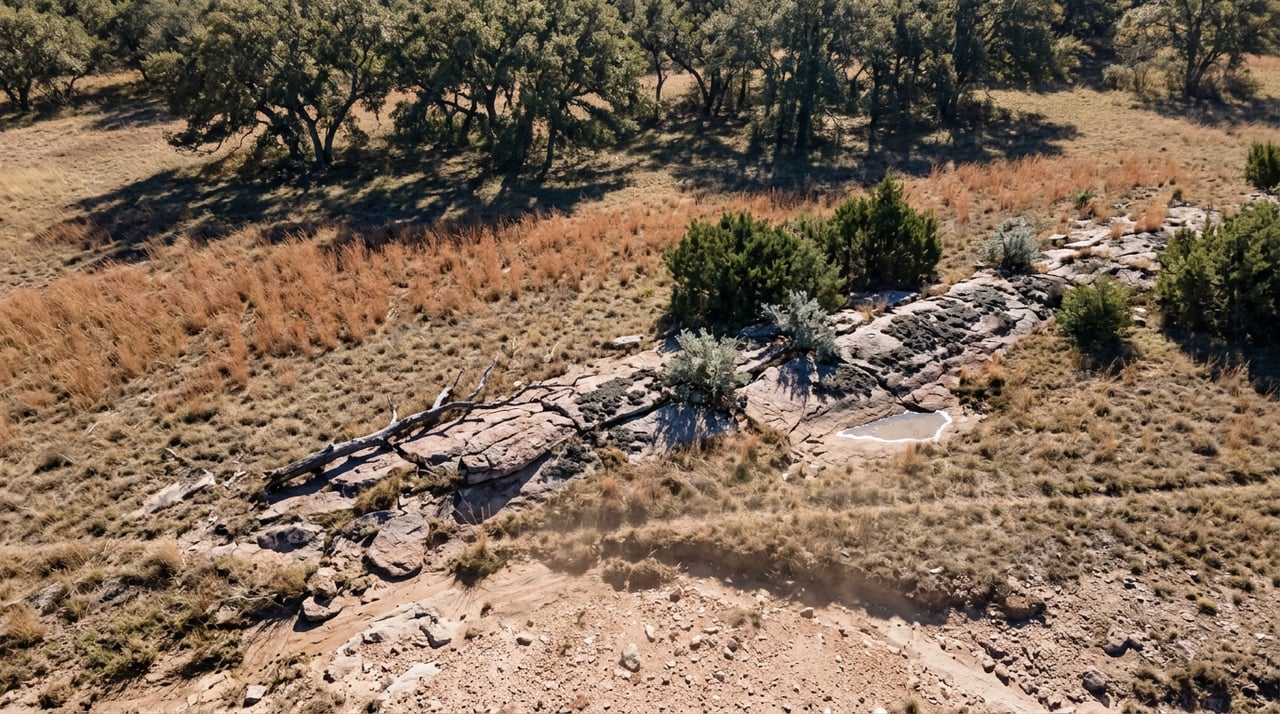
High Vista Ranch, a property southwest of Llano, lists two water wells. One produces 3 gallons per minute. The other, on the same property, produces 10 gallons per minute. Same soil survey, same rainfall, same rancher walking between them with a bucket. The difference isn't bad luck or bad drilling. It's the rock underneath, and it's the single fact that should change how you read every well disclosure on a Llano County property.
That contrast isn't an outlier. A 176-acre tract west of town lists three wells producing 10, 20, and 75 gallons per minute, all on one parcel. Granite Ridge Ranch, a 345-acre property seven miles west of Llano, carries four separate water wells alongside a surface tank and a stock trough, the kind of redundancy that only makes sense if you already know one well isn't a reliable bet. These aren't cherry-picked examples. They're what you find when you spend an afternoon reading current Llano County land listings side by side.
Why This County Drills Differently Than Its Neighbors
Fredericksburg, Kerrville, and most of the surrounding Hill Country sit on layered sedimentary limestone. Water moves through that limestone along predictable bedding planes and fracture systems, which means a driller can look at depth and terrain and make a reasonable call on what a well will produce before the bit ever touches ground.
Llano County breaks that pattern because much of it sits on the Llano Uplift, a core of granite and related crystalline rock where some formations are more than a billion years old, among the oldest exposed anywhere in Texas. Granite doesn't hold water in layers. It holds water in joints, fractures, and weathered zones that don't follow any predictable pattern across a property, let alone across the county. That's why wells in the uplift core typically complete somewhere between 150 and 400 feet, shallower on average than comparable Hill Country limestone wells, and why a fracture zone hit at 100 feet on one well tells you almost nothing about what a well 500 feet away will find at any depth.
The county isn't uniform, which matters if you're comparing tracts. The outer edges, particularly along the Llano River valley and toward the Mason, McCulloch, and San Saba county lines, transition into more sedimentary rock and behave closer to standard Hill Country limestone wells. A tract near that transition zone carries a different water profile than a tract sitting squarely in the granite core, even if both are listed at the same price per acre.
| Granite core (Llano Uplift) | Limestone Hill Country | |
|---|---|---|
| Typical completion depth | 150 to 400 feet | Often deeper, tied to aquifer layer |
| What predicts yield | Local fracture history, not depth | Depth and known aquifer position |
| Yield range on one property | Can vary 3x or more between wells | Generally more consistent |
| Low-yield backup | Storage tank often standard practice | Less commonly required |
What Happens Below Ground Doesn't Stay Below Ground
The same granite that scrambles well predictions creates a second problem most buyers don't connect to the first: septic. Llano County is one of the Hill Country counties with an active on-site sewage facility program under TCEQ regulations. Shallow bedrock, sometimes as little as 12 to 24 inches down, rules out the simplest and cheapest septic design and pushes the property toward aerobic, drip, mound, or low-pressure dosing systems instead, all of which cost more to install and maintain.
This isn't a blanket condition across every acre in the county. Parts of Llano do have the deeper, more permeable soil that supports conventional septic, and it shows up often enough in local listings that you can't assume the worst without a site visit. The point isn't that every Llano property needs an expensive system. It's that the same granite outcrops that make a ranch photograph beautifully, the ones sellers highlight for their views and hunting terrain, are frequently the same terrain features that push septic costs higher. You can't evaluate one without checking the other.
Why This Changes What a Price Per Acre Actually Buys You
Current Llano County land listings put typical raw acreage in the $7,000 to $15,000 per acre range, with riverfront and premium ranch tracts running well above that. A recently listed 840-acre property southwest of town breaks into tracts priced from roughly $12,995 to nearly $20,000 per acre depending on frontage and improvements. Those numbers sit inside a normal range for Hill Country acreage generally, which is exactly why the comparison gets misleading.
Price per acre in a limestone county and price per acre in Llano's granite core aren't measuring the same risk. In Fredericksburg or Kerrville, a seller's advertised well yield is a reasonably stable data point because the aquifer behaves consistently across a tract. In Llano, that same number might describe only the well it was measured on, with no guarantee it says anything about where you'd actually want to drill or build. A buyer comparing a Fredericksburg acre to a Llano acre at the same sticker price is implicitly assuming the same water and septic risk. That assumption doesn't hold once you understand what's underneath.
None of this means Llano County land is a worse buy. Granite outcrops are part of what gives the county its long-range views and its hunting terrain, and buyers who go in with the right expectations often find real value here. It means the due diligence has to be more granular than "there's a well on it."
What to Actually Do Before You Write an Offer
- Ask for the well completion report, not just the advertised gallons per minute. A driller's report will show depth, static water level, and yield at time of drilling, which tells you more than a listing description ever will.
- Treat every well's yield as specific to that hole in the ground, not a proxy for the whole property. If the tract has only one well and no completion report, budget for the possibility that a second well could come in very different.
- If yield tests below 3 gallons per minute, plan for a storage tank in the 1,500 to 5,000 gallon range as a standard cost of ownership, not a contingency.
- Get a soil and site evaluation before you assume a conventional septic system will work, especially on any tract with visible granite outcrops or thin topsoil.
- Even domestic wells on 10 acres or more that are exempt from production permits under Texas's groundwater framework still have to meet the district's spacing rules, according to Well Drilling Costs.
A tract that looks identical to one in Fredericksburg on a spreadsheet can carry a materially different cost of ownership once you account for what a well and a septic system will actually require here. That gap is exactly the kind of thing a site visit and a local driller's opinion catch, and a listing sheet never will.
A Few Questions Worth Asking Directly
Does a domestic well in Llano County need a production permit? If your tract is 10 acres or larger and the well is for household use, it's typically exempt from a production permit under the state's groundwater framework, but the Central Texas Groundwater Conservation District's spacing rules still apply regardless of the exemption.
How deep should I expect to drill? In the granite core, most wells complete between 150 and 400 feet, though outcomes vary more by location on the property than by planned depth. Near the county's edges, where the geology shifts toward sedimentary rock, depths and predictability start to look more like standard Hill Country wells.
What should I check if a property doesn't have a permitted septic system yet? You'll want the soil evaluation completed or at least scheduled before closing so you know what type of system the site will support and what it will cost, rather than discovering the answer after you own the land.
Land in Llano County rewards buyers who ask the right questions before they fall in love with the view. If you're comparing tracts here or anywhere else in the Hill Country and want someone who will walk the property with you and read the fine print on what's underneath it, Brittney Horton and the Wynne-Smith Horton Real Estate Group can help you sort out what a listing's numbers actually mean before you're under contract. Learn more about buying land and acreage in the Hill Country or explore what's currently available in the Llano area, then reach out when you're ready to talk specifics.
This article is general information, not legal, tax or financial advice. Consult a qualified professional about your situation.