A buyer looking at a 300-acre Mason County ranch this fall will likely see a number somewhere north of $13,000 an acre and try to make it work the way most people make land work: find the income the property generates, weigh that against the price, decide if the math holds. For Hill Country ranch land, that income usually means the hunting lease. Run that math on a typical Mason County tract and the lease covers a rounding error, not a mortgage payment. The number that actually decides whether the deal pencils out isn't on the lease agreement at all. It's on the county tax roll, and it depends on paperwork the seller may or may not have kept current.
That distinction matters more in Mason County than almost anywhere else in the Hill Country, because the county's land trades at a real premium over the regional average, and the reason for that premium has less to do with what the land produces than with what the tax code lets an owner avoid paying.
What the Per-Acre Number Actually Buys
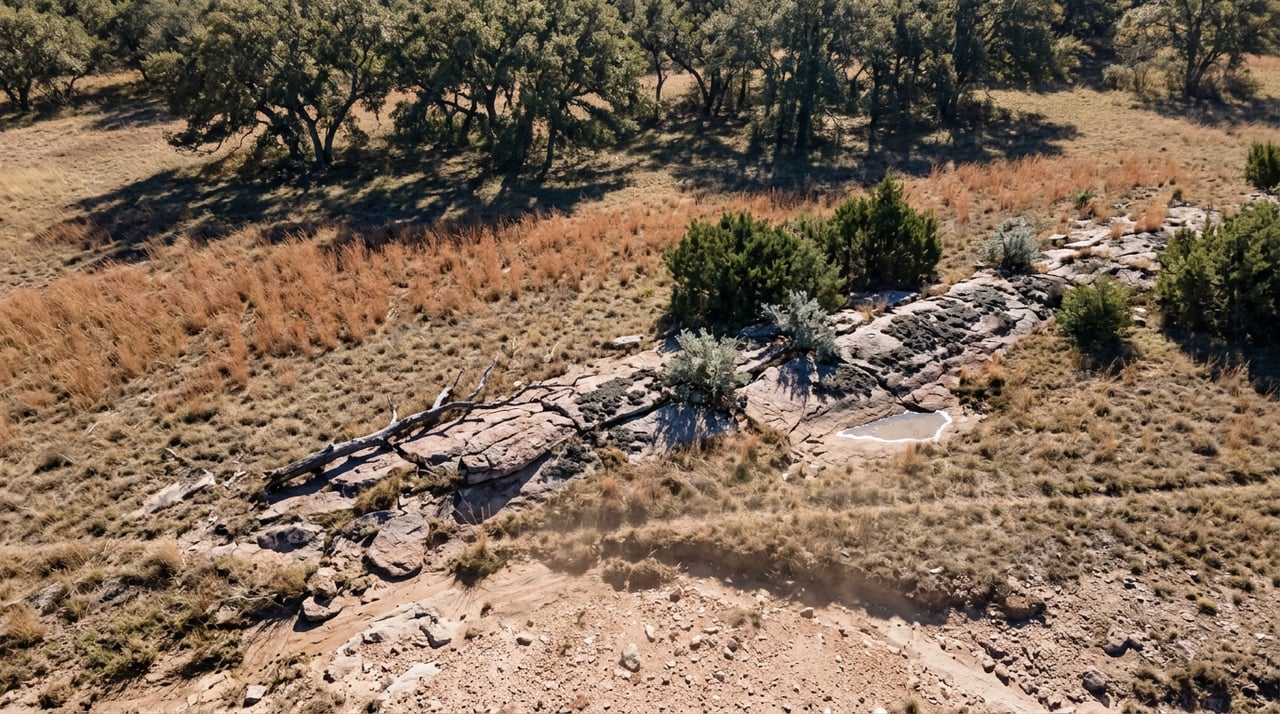
Current land listings across Mason County cluster in the $11,000 to $14,000 per acre range, depending on which slice of the market you're looking at. That's a meaningful step up from the broader Austin-Waco-Hill Country region, which averaged $7,704 an acre in 2025 sales, a record for the region according to Texas Farm Credit's land pricing data. Mason isn't pricing like the regional average. It's pricing like a county with something the rest of the region doesn't have in the same concentration: Llano River frontage, granite outcrops that hold water and wildlife differently than the limestone country to the east, and a run of legacy ranches that rarely change hands.
Walk through what's actually on the market right now and the range makes more sense. A 3,288-acre spread like Comanche Springs Ranch sits at one end. A 97-acre tract like Cave Ranch, held by the same family since 1962, sits at the other. Somewhere in between you'll find working properties in the 100 to 250-acre range with a house, a pond, and enough native pasture to run cattle or hold a lease. The acreage varies. The per-acre price across most of it doesn't move as much as you'd expect for such different property types, which tells you the market is pricing something closer to the tax and land-use characteristics of Mason County as a whole than the individual features of any one ranch.
A few years ago, the county's other calling card as a source of income quietly disappeared. Mason is the only place in Texas where the state's official gemstone, blue topaz, occurs in the wild, and for more than a decade a handful of working cattle ranches let rock hunters dig for it for a small daily fee. Deloris Lindsay of the Lindsay Ranch was the last holdout. When she closed her gates, she told Texas Monthly she'd simply reached an age where she didn't want to worry about "people driving off into a creek" anymore. The topaz fee was never a real income line on anyone's ranch ledger, but its disappearance is a useful reminder for buyers: whatever small side income a Hill Country property seems to carry, it's rarely the reason the numbers work. Something else is.
The Hunting Lease Is a Rounding Error, Not a Business Plan
Here's the number a lot of buyers lean on. A typical native Hill Country hunting lease runs $20 to $30 an acre, and the better-managed ranches in Mason and Llano counties push $35 to $40. Add a Managed Lands Deer Program designation and you can tack on another $5 to $10 an acre on top of that.
Run the generous version of that math on 300 acres. A $40-an-acre lease with the MLDP premium gets you to roughly $15,000 a year in lease income, on a property that likely cost somewhere north of $3.5 million at Mason County's going per-acre rate. That's well under half a percent of purchase price. It's real money, and it's genuinely useful for covering fencing, feed, or a ranch hand's time. It is not the thing that makes a multimillion-dollar land purchase financially sensible on its own, and any diligence process that treats it as the load-bearing number is going to miss the actual mechanism.
The Real Discount Is On the Tax Roll, Not the Listing Sheet
The mechanism that actually matters is Texas's agricultural and wildlife management property tax valuation, and the swing it produces is large enough to change how a buyer should think about carrying cost entirely.
| Valuation basis | Approximate annual tax burden |
|---|---|
| Full market value | Roughly $50 to $200 per acre |
| Ag or wildlife management (1-d-1) productivity value | Roughly $0.50 to $2 per acre |
On a 300-acre ranch, that's the difference between a tax bill that could run $15,000 to $60,000 a year at market value, and one that could run a few hundred dollars a year under the productivity valuation. That gap dwarfs anything the hunting lease brings in. It's also the reason a ranch priced at $13,000 an acre can be genuinely affordable to hold year over year for an owner who qualifies, and genuinely expensive for one who doesn't.
The Texas Comptroller's office and the Texas Parks and Wildlife Department jointly administer this, and the rules are specific enough that they reward a buyer who checks them before closing rather than after.
Why That Discount Doesn't Automatically Follow the Deed
The productivity valuation isn't something a new owner can simply apply for on day one. A property must already be qualified under the standard agricultural (1-d-1) or timber valuation before it can convert to a wildlife management valuation, and that prior qualification typically means the land was devoted to agricultural or timber use for at least five of the preceding seven years. Buy raw land that's never carried an ag valuation and you're not stepping into the wildlife program on closing day. You're starting a multi-year process.
Once a property does qualify, keeping the valuation active means the landowner has to actually do something with the land every year. The rules require implementing at least three of seven designated wildlife management practices, which include things like habitat control, providing supplemental water, predator control, or conducting census counts, and filing a wildlife management plan with the county appraisal district. Skip that upkeep and the county can revert the property to market value, which can trigger back taxes.
There's a second wrinkle that matters specifically for buyers looking at smaller tracts carved out of larger Mason County ranches, which is common in a county where legacy properties get subdivided among heirs or sold off in pieces. If a tract has been reduced in size since January 1 of the preceding tax year, a minimum acreage requirement kicks in, set by the chief appraiser based on the ecoregion. A 40-acre parcel that split off a larger ranch last year may not clear that bar even if the parent property qualified for decades. This is exactly the kind of detail that shows up in county appraisal district records, not in the marketing photos.
What to Confirm Before You Write the Offer
- Ask the county appraisal district whether the property currently carries a 1-d-1 agricultural or wildlife management valuation, and for how long
- Request a copy of the current wildlife management plan on file, if one exists
- Confirm whether the tract has changed in size since January 1 of the prior tax year, and if so, whether it meets the county's minimum acreage rule for wildlife valuation
- Ask what specific wildlife management practices have actually been performed in the last twelve months, not just what the plan lists
- Understand what happens to the tax bill in the first year of your ownership if the valuation lapses during the transaction
None of this shows up as a line item on a listing sheet. It shows up in a phone call to the appraisal district and a review of the seller's filed paperwork, and it's worth doing before you get attached to a number that assumes the valuation just comes along for free.
A Couple of Questions Worth Asking Directly
Does the wildlife valuation automatically transfer to me when I buy the ranch? The valuation is tied to the land's qualifying use, not the owner, so a new buyer who continues the required management practices generally keeps the benefit. What doesn't transfer automatically is compliance. If the previous owner let the annual practices lapse before closing, the burden falls on the new owner to demonstrate the property still qualifies.
What if the ranch I'm looking at was carved out of a larger tract recently? Check with the county appraisal district before you write an offer. Minimum acreage rules only apply when a tract has shrunk since the prior tax year, and the required minimum depends on the ecoregion the county sits in. A property that looks identical to its neighbors on paper can fail this test if it was recently subdivided.
Mason County land rewards buyers who read the tax roll as carefully as the survey. If you're weighing a ranch purchase or thinking through what a property's real carrying cost looks like once the paperwork is verified, Wynne-Smith Horton Real Estate Group works these transactions across Fredericksburg and the surrounding Hill Country, including Mason County. Contact us to talk through what a specific property's valuation history actually supports before you make an offer.